Hooliganism in America

Video made for university magazine Zero/Nil‘s website. Made in conjunction to an editorial piece investigating how Britain’s hooligan culture never made its way to the US.

All images and videos used are under a Creative Commons Licence. Leave a message at the ‘contact.’ page for removal of images or videos.

City News (4th March 2022)

Ukraine, sustainability in London, and more to come in the programme.

I was this week’s director, which meant my responsibilities included: being in charge of ensuring the show goes to air, working with the lecturers in the gallery to run the operating board (Tricaster vision mixer), blocking the show prior to airtime to determine order of camera shots, graphics, and video outputs, and troubleshooting any technical issues that arise while running the operating board

City News Radio (18th Feb 2022)

Storm Eunice, Ukraine, cost of living, and more to come in the programme.

I was this programme’s outtake editor, with my responsibilities including:

  • Before the programme make sure all jingles, music and production elements are loaded correctly into Burli or the playout system 
  • Liaise with the live and beat reporters on how their pieces will work 
  • Work with the assistant/desk producer on making the openers and teasers/promos 
  • During the show operate Burli and liaise with the desk producer to make sure the show finishes on time at each junction

I did well to drive the desk, making sure the levels were consistent through the show, cuing presenters, and cutting the programme up with jingle stings. I also helped with the Fashion Week and COVID sections, editing the copies for them, and editing audio for parts of their packages.

City News Radio (11th Feb 2022)

Metropolitan Police, President Biden on Russia, Ukraine, and more in the programme!

For this weeks programme I was the production producer, which saw me create content for on-air (jingles, actuality clips, and packages), drive the 2nd production desk in the secondary studio, and provide a ‘creative moment’ to lighten the programme.

Highlights of my role can be seen at:

(1:53) (30:55) (32:40)
These are the bulletins I had to drive the desk for. The trouble is, the script did not match up with what actually happened on air – with producers and editors telling me once we’d gone live what was happening. Because of this, I had to listen out for cues that weren’t written in the script to get the right mics live

(24:15)
I helped entertainment producer/presenter Linda a lot with her stories: editing the copy, providing a number of actualities for her to choose from, and writing a segue to my later package later in the programme.

(50:10)
This package was my “creative moment”. I was a little confused as to what that was supposed to be, and after talking to the editor and the previous week’s producer, this is what I understood the creative moment to be. It was also a challenge tonally. I’m so used to the intonations and tone of a presenters voice but had to make myself sound more colloquial for this package.

Yellow Press

‘Yellow Press’ or ‘Yellow Journalism’ was an American journalistic style that came to prominence in the latter half of the 1800s; This said style, as Gullason (1959, pp. 202) explains, had, “a dependence on ‘the familiar aspects of sensationalism-crime news, scandal and gossip, divorces and sex, and stress upon the reporting of disasters and sports’.” Adding to that, he would also note the Yellow Press for its lenient attitude towards truth and accuracy, relying more so on its eye-catching nature for sales. With pioneers such as W. T. Stead bringing this American style to Britain, British papers would be flush with Yellow Press heading into the 20th century. It’s influence on the eras of journalism that would succeed it is evident, especially in the New Journalism that swept Britain around the same time — with Hampton (2004) depicting the two styles more so as vehicles to entertain and give readers what they want, rather than to accurately inform.

Yellow Journalism is most easily defined by four key characteristics: eye-popping headlines in large print, use of multimedia such as pictures and comics, often misleading or untrue statements from sources due to chequebook journalism, and the implementation of an ‘underdog’ narrative (Mott, 1941). These fundamental elements would first arise in the heated feud between William Randolph Hearst and Joseph Pulitzer in the late 1890s, in which the term ‘Yellow Press’ is coined (Department of State, n.d.). Pulitzer and Hearst — along with James Gordon Bennet Jr. — would organise their reporters to look for “scoops” and “beats” in an effort to be the first to break news; This scramble for fast reporting and trying to outsell the competition led to lapses in accuracy as statements by sources weren’t always checked up on (Wiener 1994). Competition, especially in the New York newspapers — as well as the reportage of conditions in Cuba leading up to the Spanish-American War — would lead to the profound mass production of Yellow Press in the States by the end of the 19th century.

Lee (1976, pp. 232), in explaining why Britain had to adopt the capitalist business model American newspapers had adopted, said: “In the simplest of terms, the press had become (by 1914) … a business entirely, and a political, civil, and social institution hardly at all.” British newspapers would first embrace the use of sensationalism — and introduce the use of telling the story through headlines and subheadings or crossheads — in covering the murders committed by Jack the Ripper in 1888 (Knelman, 1993). The introduction of crossheads and hooking titles would be introduced by William Thomas Stead, a key figure in bridging the American Yellow Press style into Britain. At his time working for the Pall Mall Gazette Stead would also incorporate illustrations and line drawings into stories; he was also pivotal in introducing more interviews and ‘character sketches’ that blended interviews, word pictures and personality analysis (Honigsbaum, 2019). Onward, through to 1900, British newspapers would adopt the American’s Yellow Press style of fast reporting, increased informality, putting a spotlight on crime reporting as well as gossip, and sensationalising stories (Wiener, 1994).

Another large factor as to how the American style of press reached Britain was with the laying of the transatlantic telegraph cable in 1966 between the two countries. All of a sudden, British and American reporters and writers were able to openly communicate with each other and influence each other in the development of stories. Not only that, but the going ons of Europe — specifically conflicts — could now reach the US faster than ever and vice versa; McLaughlin (2016, pp. 66), on explaining why the speed of the transatlantic telegraph cable was important, said: “An account of the battle of Metz on 19 August appeared only two days later in the New-York Tribune. Such a commitment cost the Tribune some $5,000, but it was a sound investment: it boosted circulation and thus profits in an era of intense competition to be first with the news.” With conflicts such as the Spanish-American War and the Franco-Prussian War leading to more communication between British and American war reporters, war reportage in general became a key reason as to how the American style influenced British journalists.

McKerns (1976, pp. 27) would state the one key difference between the Yellow Press and Britain’s New Journalism: “The “Yellow Journalism” of the 1890’s was the New Journalism without its social consciousness.” Critics of the Yellow Press and Britain’s New Journalism, such as Arnold (1887), look to the use of false or exaggerated information as their main gripe. Yet,  despite this, British new journalists would introduce and provoke the popularisation of investigative journalism in Britain, especially on social issues. William Thomas Stead, after arriving at the Pall Mall Gazette would commission stories on London gangs and housing conditions in the East End (Honigsbaum, 2019). One of his most pivotal works, Maiden Tribute of Modern Babylon, was a an expose on prostitution in England — specifically child prostitution. With its publication, came the repealing of the Contagious Diseases Acts and the age of consent being raised from 13 to 16. The investigative journalism that looked into social issues came with Britain’s New Journalism, but wasn’t present in America’s Yellow Journalism.

The impact American Yellow Press had on British New Journalism hasn’t been overstated in the slightest. The parallels — sensationalism, fast news, illustration, gossip columns, falsifying and exaggerating facts — are evident between the two and can even be seen today in tabloid journalism. The pioneers of the two genres: Pulitzer and Hearst in the US, and Stead in Britain, were able to popularise the monitisation of the newspaper industry, devolving it from a public service to a business. And, though there lied one key difference between the two genres in terms of subject matter, it’s minimal in the face of the similarities.

References

Arnold, M. (1887) ‘Up to Easter’, The Nineteenth Century, May, pp. 629-643

Department of State (n.d.) U.S. Diplomacy and Yellow Journalism, 1895–1898. Available at: https://history.state.gov/milestones/1866-1898/yellow-journalism (Accessed at: 21 February 2020)

Gullason, T.A. (1959) ‘Stephen Crane’s Private War on Yellow Journalism’, Huntington Library Quarterly, 22(3), pp. 202

Hampton, M. (2004) ‘Liberalism, the Press, and the Construction of the Public Sphere: Theories of the Press in Britain, 1830-1914’, Victorian Periodical Review, 37(1), pp. 73

Honigsbaum, M. (2019) ‘The ‘yellow press’ and the New Journalism’ [PowerPoint presentation]. JO1205, History of Journalism. Available at: https://moodle.city.ac.uk/course/view.php?id=32283 (Accessed: 23 February 2020)

Knelman, J. (1993) ‘Transatlantic Influences On the Reporting of Crime: England vs. America vs. Canada’, American Periodicals, 3, pp. 3

Lee, A.J. (1976) ‘The Origins of the Popular Press in England, 1855-1914’. London: Rowman & Littlefield Pub Inc, pp. 232

McKerns, J.P. (1976) ‘The History of American Journalism: A Bibliographical Essay’, American Studies International, 15(1), pp. 27

Mclaughlin, G. (2016) The War Correspondent. London: Pluto Press, pp. 66

Wiener, J.H. (1994) ‘The Americanisation of the British Press, 1830-1914’, Media History, 2(1-2), pp. 63

Union Chapel

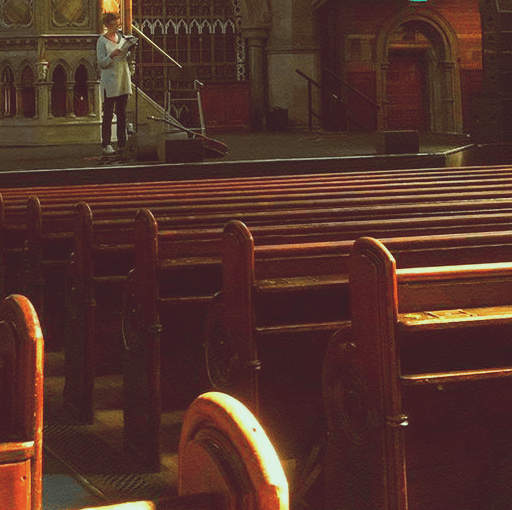
With the gale winds and gentle drizzles of Storm Dennis encroaching on what could’ve been a pleasant Saturday morning, litters of men and women slowly slither their way up to Compton Avenue in Islington. A hoarse female voice buzzes you through the aged wooden doors and, welcomed by aromas of free tea and coffee, the over 200 year old concrete maze soon feels rigid and intrusive. Those feelings soon subside once met with a hearty handshake and a thankful smile.

It doesn’t take long for commotion to arise: musicians flock in and out the green room, ‘volunteer’ lanyards are passed around, pews are dusted. And then at noon — with arms outstretched to the community — Union Chapel gradually teems with souls and voices.

Sat between the trendy cafes of Upper Street and deluxe apartments of Canonbury Square, the Gothic 19th century structure not only stands as a looming presence amongst the more diminutive buildings but also as a bastion — the centrepiece of a community.

Being purely a place of worship has become a rarity in modern London churches. With a 2018 report released by The National Centre for Social Research revealing that less than 40% of Britons believed themselves to be Christian and less than a third of the country attends church services regularly, churches have had to adapt with the times.

Union Chapel, every Saturday, hosts ‘Daylight Music’: a pay-what-you-can midday concert with up to 30 acts — an eclectic mix of young aspiring musicians, poets, and theatre acts. “It was the idea of giving a stage to people who wouldn’t get a chance to play,” said Ben Eshmade, the founder and producer of Daylight Music. “The building itself is a sort of meditative space, and it’s just so different seeing the venue in the daytime rather than the night. It became very clear that there was a whole community out there of people who could use or benefit from the chapel being open on Saturday mornings. It’s just a great way of starting the weekend.” Ben has run Daylight Music on 330 Saturdays since launching the project 11 years ago. The money raised, first a foremost, goes to paying the artists performing; Left over proceeds go directly to the church and their efforts in restoration and aiding the homeless.

Playing its part in bringing together Highbury & Islington’s artists, the chapel carries importance for its role in aiding the homeless and disenfranchised. Since 1992, the red and white tower has provided those of need with a hot shower, a warm bed, food, and clean clothing with their ‘Margins Project’. Andrew Mitchell, who’s lived in the area for more than 30 years, has been a regular volunteer for the program. “London, as with most big cities, has a problem with homelessness. Even if we can only take in as many as we can at a time, hopefully other places can follow from our example and help carry the weight.” As well as housing and tending to those in need, the Margins Program helps those struggling by offering English tuition and employing them at the chapel’s cafe to improve their employability. “We’ve recently had someone come in whose just not been able to make ends meet since his parents passed. Right now he’s helping out at the Margins Cafe — being taught skills in catering and keeping him somewhere safe — and hopefully he can take that forward into something more fortunate.”

If anything, the multi-faceted Union Chapel serves as a microcosm of what the modern British church is becoming — no longer just a place of worship but these community hubs that bind together the people and groups around them. And, though a prime example of this, Union Chapel isn’t the only secular organisation turning toward community building. Just down the road in Angel, St Silas holds Alcoholics Anonymous meetings, hosts for the local orchestra, and has theatre classes. St James Church in Islington hosts a variety of events — such as music lessons and ballet classes — aimed at young children whilst also holding yoga classes and meditation sessions for adults.

Union Chapel had to adapt and it adapted; it was saved from demolition in 1982 and 29 years later is now listed as a Grade I building. Through the compassion it’s shown its community, the community has shown it back in its donations to the Union Chapel Project and those volunteering for the Friends of Union Chapel helping restore and preserve the building.

Margaret Grangier, a local mother of two, has over the years seen Union Chapel integrate itself people’s lives: “I never came regularly at the beginning, purely because I wouldn’t say I’m the most religious person, but I started coming round to the concerts on Saturday mornings and to the cafe on Wednesdays. Eventually, it just becomes a part of your life. You start to see that in everyone who comes here as well; you’ll often come round asking people if they’d like to join the mailing list — the room would be packed but a majority of people would still say they’re already on it.”