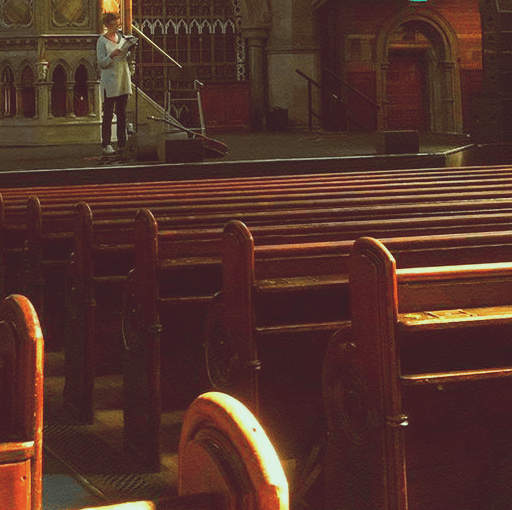
With the gale winds and gentle drizzles of Storm Dennis encroaching on what could’ve been a pleasant Saturday morning, litters of men and women slowly slither their way up to Compton Avenue in Islington. A hoarse female voice buzzes you through the aged wooden doors and, welcomed by aromas of free tea and coffee, the over 200 year old concrete maze soon feels rigid and intrusive. Those feelings soon subside once met with a hearty handshake and a thankful smile.
It doesn’t take long for commotion to arise: musicians flock in and out the green room, ‘volunteer’ lanyards are passed around, pews are dusted. And then at noon — with arms outstretched to the community — Union Chapel gradually teems with souls and voices.
Sat between the trendy cafes of Upper Street and deluxe apartments of Canonbury Square, the Gothic 19th century structure not only stands as a looming presence amongst the more diminutive buildings but also as a bastion — the centrepiece of a community.
Being purely a place of worship has become a rarity in modern London churches. With a 2018 report released by The National Centre for Social Research revealing that less than 40% of Britons believed themselves to be Christian and less than a third of the country attends church services regularly, churches have had to adapt with the times.
Union Chapel, every Saturday, hosts ‘Daylight Music’: a pay-what-you-can midday concert with up to 30 acts — an eclectic mix of young aspiring musicians, poets, and theatre acts. “It was the idea of giving a stage to people who wouldn’t get a chance to play,” said Ben Eshmade, the founder and producer of Daylight Music. “The building itself is a sort of meditative space, and it’s just so different seeing the venue in the daytime rather than the night. It became very clear that there was a whole community out there of people who could use or benefit from the chapel being open on Saturday mornings. It’s just a great way of starting the weekend.” Ben has run Daylight Music on 330 Saturdays since launching the project 11 years ago. The money raised, first a foremost, goes to paying the artists performing; Left over proceeds go directly to the church and their efforts in restoration and aiding the homeless.
Playing its part in bringing together Highbury & Islington’s artists, the chapel carries importance for its role in aiding the homeless and disenfranchised. Since 1992, the red and white tower has provided those of need with a hot shower, a warm bed, food, and clean clothing with their ‘Margins Project’. Andrew Mitchell, who’s lived in the area for more than 30 years, has been a regular volunteer for the program. “London, as with most big cities, has a problem with homelessness. Even if we can only take in as many as we can at a time, hopefully other places can follow from our example and help carry the weight.” As well as housing and tending to those in need, the Margins Program helps those struggling by offering English tuition and employing them at the chapel’s cafe to improve their employability. “We’ve recently had someone come in whose just not been able to make ends meet since his parents passed. Right now he’s helping out at the Margins Cafe — being taught skills in catering and keeping him somewhere safe — and hopefully he can take that forward into something more fortunate.”
If anything, the multi-faceted Union Chapel serves as a microcosm of what the modern British church is becoming — no longer just a place of worship but these community hubs that bind together the people and groups around them. And, though a prime example of this, Union Chapel isn’t the only secular organisation turning toward community building. Just down the road in Angel, St Silas holds Alcoholics Anonymous meetings, hosts for the local orchestra, and has theatre classes. St James Church in Islington hosts a variety of events — such as music lessons and ballet classes — aimed at young children whilst also holding yoga classes and meditation sessions for adults.
Union Chapel had to adapt and it adapted; it was saved from demolition in 1982 and 29 years later is now listed as a Grade I building. Through the compassion it’s shown its community, the community has shown it back in its donations to the Union Chapel Project and those volunteering for the Friends of Union Chapel helping restore and preserve the building.
Margaret Grangier, a local mother of two, has over the years seen Union Chapel integrate itself people’s lives: “I never came regularly at the beginning, purely because I wouldn’t say I’m the most religious person, but I started coming round to the concerts on Saturday mornings and to the cafe on Wednesdays. Eventually, it just becomes a part of your life. You start to see that in everyone who comes here as well; you’ll often come round asking people if they’d like to join the mailing list — the room would be packed but a majority of people would still say they’re already on it.”
 VAGABABOND: 2XXX